Chatuge’s 3-Gun is built for safety and for shooters of every level: three separate stages, pistol only, rifle only and shotgun only, timed as one event. Nobody moves between stages with a loaded gun or switches guns within a stage, and the club does not charge for this match.
Upcoming dates
How it works
- Two classes: Limited (iron sights; 7 rounds in the pistol, 10 in the rifle, 4 in the shotgun) and Open (optics allowed, no magazine limits).
- Handguns start at low ready or unloaded on a staging table, not drawn from a holster.
- The order of the firearms and the targets is explained before each stage.
Scoring
Your time plus penalties: 3 seconds for a paper target not neutralized, a steel miss or a clay not at least half broken; 10 seconds for hitting a no-shoot; 5 seconds for a procedural error.
Past results and photos
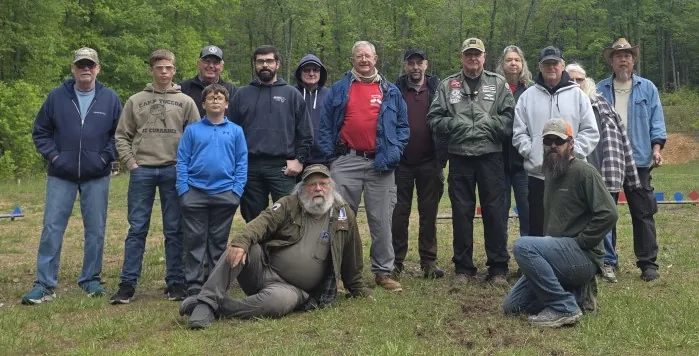 2May 20263-Gun RimfireMatch director: Josh Warman
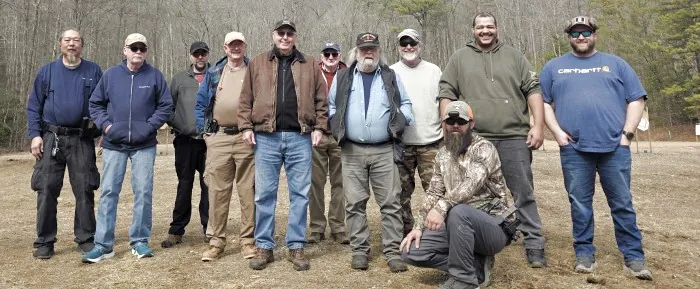 14Feb 20263-Gun CenterfireMatch director: Josh Warman
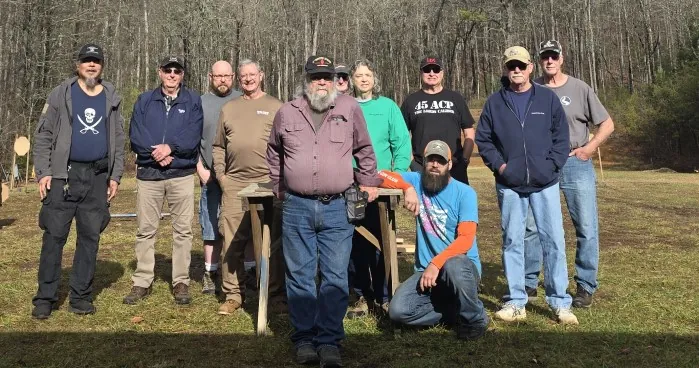 22Nov 20253-Gun CenterfireMatch director: Josh Warman
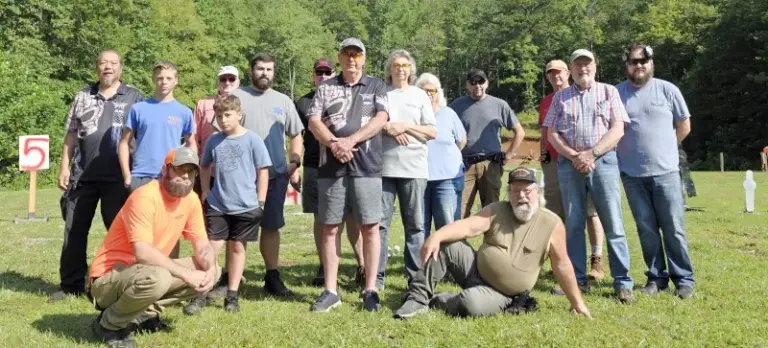 16Aug 20253-Gun RimfireMatch director: Josh Warman
Read the full rules, as the match director wrote them
Chatuge Gun Club Three-Gun Match Description July 2021 Chatuge Gun Club endeavors to offer a safe match that will be challenging, competitive and enjoyable for all but, all rules are designed to suit our range and membership. We do not charge for this match. In order to maximize safety and still be a skills test for shooters from beginner level through senior ages, we will not support standard 3gun guidelines by moving from one stage to another with loaded firearms. We do not support transitioning from one firearm to another within a stage. All courses of fire will consist of three separate stages ie, pistol only, rifle only and shotgun only. These three stages are timed as a single event.
FIREARMS AND AMMUNITION
A. Handguns – Any centerfire pistol or revolver will be allowed. There will not be a “power factor” or other attempt to classify handguns. However, the match will be timed and there will be reloads, so you may want to choose an autoloader over your revolver. Handguns will not be drawn from a holster however, holsters are encouraged as they allow the shooter to stage and unstage weapons more quickly. This will save time when handling of three firearms is required between shooters. Handgun stages will begin from the low ready position or unloaded on a staging table. While fewer rounds may be actually used, it is suggested that you bring at least 100 rounds.
B. Shotguns – All long shotguns will be permitted; however, since time will be a factor, you may want to take autoloaders into consideration. Shells must be #4 lead shot or a smaller size. Buckshot and/or slugs will be a part of the course of fire. Steel shot is not allowed. It is suggested that you bring at least 50 rounds of shot, 4 buckshot and 4 slugs.
C. Rifles – Any centerfire rifle of .30 caliber or less will be permitted, also any rifle that fires a pistol caliber is permitted; however, again, considering the format, you may want to choose a magazine-fed semi-automatic rifle. It is suggested that you bring at least 100 rounds. No magnum, armor piercing, green-tip steel penetrator (XM855), tracers or incendiary rounds are permitted. Bring several magazines as mag changes will be part of the stage format. Suggestion is 3, 30 round magazines and 80 rounds. Pistol caliber carbines are allowed but must be shot in the rifle stage only. Firearms not allowed will be any long gun that is not fitted with a shoulder stock. Long guns must be fired from the shoulder. Rifles fitted with bump stocks or binary triggers are also not allowed.
OTHER EQUIPMENT
A. Clothing – concealment type garments are not required.
B. Open Bolt Indicators/Chamber Flags- All long guns will need to display an open bolt indicator (OBI) when not in use. Chamber flags will be available for purchase at the match if anyone needs them.
C. Magazines and Reloads – There will be reloads required for each stage, so additional magazines will be necessary for pistols and rifles. It is suggested that a minimum of three
(3) of each be brought. Shells for shotgun reloads may be either carried in a pouch, shell caddy, or positioned with the shotgun on a table. Magazines can be loaded anytime during the match.
D. Magazine pouches-Not required but saves time between shooters if you’re not picking mags up off the ground. This is always awkward when trying to stage and unstage between shooters.
E. Slings – Slings are permitted, but will not be necessary as long guns will be positioned rather than carried.
F. Holsters – The holster material must completely cover the trigger on all pistols. The belt upon which the holster is attached must be secured at waist level. Tactical thigh holsters are permitted and must be secured at waist level. Due to safety concerns, shoulder holsters, inside the waistband, concealed types and cross draw holsters are specifically not allowed.
CLASSIFICATIONS
There are two classifications – Limited and Open. Guns that meet the Limited class definition can compete in the Open class if they want, but not the other way around.
A. Limited Class – All firearms in the limited class can only have iron sights – no optics, lasers or red dot scopes are allowed in this class. There are limitations on the ammunition loading to make it competitive for firearms with limited capacity. Handgun magazines can only be loaded to a maximum of seven rounds. Rifle magazines can only be loaded to a maximum of ten rounds and shotguns can only be loaded with four rounds.
B. Open Class – Red dot optics or scopes are permitted on all firearms in the open class and there are no magazine loading limits in the open class unless otherwise specified in the stage briefing.
STAGES
There will be seperate scenarios that will require the specified use of the three firearms at different targets. The goal of the stage design is to try to utilize different shooting skills for each firearm. The order that the firearms are to be used and the targets engaged will be explained before each stage. The distances to the targets will vary – 10yds to 100yds for rifle targets, 3yds to 20yds for handguns and 10yds to 50yds for shotguns. There will be some movement for the shooter during a stage; however, it will be limited.
SCORING
A. Paper targets – Most of the handgun and rifle targets will be the standard IDPA cardboard silhouette. Each target will either be neutralized or a three second FTN(failure to neutralize) penalty will be applied. +3 sec A target can be neutralized in two methods:
- One shot in either of the -0 scoring areas (head or chest) will neutralize the target – or two shots anywhere on the target will neutralize the target. The hit or hits only need to touch or break the perforation to avoid penalty.
B. No-shoot targets – There may be hostage or “no-shoot” targets on a stage. A hit on any hostage target will result in a ten second penalty. +10 sec Hostages will be typically painted a different color or will have raised hands painted on them.
C. Steel targets – Steel plates or gong targets may be used and will be scored as a hit or a three second penalty will be applied. +3 sec
D. Clay targets – Clay pigeons may be used for shotgun targets. At least 1/2 of the clay must be broken or a three second penalty will be applied. +3 sec
E. Procedural violations – The order and method that the targets are to be engaged will be specified. Failing to follow the described course of fire will result in a five second procedural penalty. +5 sec (For example – shooting the firearms in the wrong order, engaging the targets in the wrong order, shooting with two hands when it is specified to be one handed only, etc)
F. Manual safety – Failure to engage a manual safety on a loaded firearm upon moving to the next stage will be a five second penalty. +5 sec
G. Bonus – announced at stage briefing.
SCORING PENALTIES
Any aerial clay target missed +3 sec Single hit on paper outside the center ring at any distance +3 sec Miss on Target (MOT)-No hits on paper or steel +3 sec Failure to engage (FTE)-any target less than 100 yards +5 sec Each hit(s) on a No-Shoot (NS) target +10 sec Procedural violation +5 sec RANGE EQUIPMENT FAILURE If a target falls or fails without being engaged, (i.e. wind action) after the start signal, the range officer shall stop the competitor as soon as possible. The competitor will then be required to re-shoot once the COF has been restored. Range Equipment Failure can include the timer. If at any time prior to the final event scores being posted RO has determined that the timer, for any reason, failed to record the actual last shot or that the time posted is deemed to be improbable and/or impossible the competitor will be required to re-shoot the COF or receive a Did Not Finish (DNF) score for the COF in question.
Note: If required, the competitor has the option to re-shoot the COF immediately or be moved to the bottom of the shooting order BURNING
Discharging or “Burning” rounds is allowed, but the firearm MUST be discharged in a safe direction impacting a berm or backstop. Long guns MUST be shouldered while “Burning” any round(s). A violation of this rule is considered an unsafe action and will result in a match DQ.
SAFETY
Safety is of utmost importance. Before the match begins, all handguns will be verified to be empty with magazines removed and hammer down; thereafter, handguns may be carried holstered in that manner. If handguns are not carried holstered, they may me positioned on shooting tables with the shooters equipment (visible) with magazines out and slides locked back. Otherwise handguns will be stored in closed cases with magazines out. All long guns will be unloaded, magazines empty, actions open and chamber flags inserted. All long guns will remain in the racks until the shooter is called to the line. TRANSPORTING FIREARMS (To and from vehicles or between stages) Pistols must be transported from vehicles or between stages cased. Long Guns must be transported with the bolt closed on a chamber safety flag, detachable magazines must be removed and magazine tubes unloaded. Long Guns should be cased OR if hand carried or slung, the muzzle must be pointed up. Using a cart where the muzzles are pointed up or down is allowed, as long as they are secured properly in the cart.
Note: The ONLY time a long gun may not have a chamber safety flag inserted is after the “Make Ready” command or in a Safe Area.
TRIGGER DISCIPLINE
The competitor’s finger must be visibly outside the trigger guard when moving, loading, reloading or unloading during a COF and while clearing a malfunction. Failure to comply with any Verbal Warnings will result in a Match DQ. Exception: When actually aiming or shooting at targets or while complying with the “Make Ready” command to lower the hammer of a pistol without a de-cocking lever.
NEGLIGENT DISCHARGE
A negligent discharge that occurs while loading, reloading, unloading, while transitioning a long gun off or back to the shoulder, during malfunction and remedial action, clearing a firearm, transferring a firearm between hands, or during movement (except while shooting at legitimate targets) will result in a match DQ.
Definition: An unintentional shot (including a slam-fire) which travels over a backstop, a berm, or impacts anything deemed by the event organizers to be unsafe.
Note: In the case of a negligent discharge, the RO will stop the competitor as soon as safely possible.
Exception: A competitor who fires a shot at a legitimate target, which impacts and travels in an unsafe direction, through ricochet or bounce will NOT result in a match DQ. A confirmed shot striking the ground less than 9′ feet (3yds) from the competitor is considered a safety violation and will result in a match DQ.
180-DEGREE SAFETY PLANE
A competitor that allows the muzzle of a firearm to break the 180-Degree Safety Plane will be issued a match DQ.
Exception: Except with a pistol while holstered, drawing and reholstering.
Definition: The 180-Degree safety plane is defined by an arc both horizontal and vertical that is created when the competitor is standing facing squarely downrange and parallel to, the designated backstop used on the bay to define the 180-Degree safety line on that particular stage.
Note: Any position where the muzzle points back towards the shooters position past the designated 180-Degree safety line is a violation of this rule and considered an unsafe action.
EQUIPMENT MALFUNCTIONS
Malfunctions will be dealt with in a safe manner and will be scored as such. In the interest of time and fairness to others, there will be no restarts. Shooters will be allowed 30 seconds on the timer to clear a malfunction before time is called by a “Move On” or “STOP” command. After the “MOVE ON” command the shooter will disengage the firearm and move to the next stage. After the “STOP” command the shooter will make the weapon safe and place it on the staging table. After completing the COF any targets not engaged will be scored as FTE. If a malfunction occurs on the final stage a 30 second time will be added to the final shot time. At any time during a COF the shooter wishes to disengage and not use the 30 seconds to clear, shooter may lay the firearm on the staging table and call for a time. At this point the time will be recorded and all remaining targets will be recorded as FTE.
DROPPING OF FIREARMS
Any dropping of a loaded firearm will result in an immediate DQ.
COMPLIANCE INSPECTION
Refusal to submit to an equipment compliance inspection or to a pre-loaded shotgun inspection will result in a match DQ.
EXPECTED SHOOTER CONDUCT
Competitors and spectators are expected to conduct themselves in a courteous, sportsmanlike manner at all times. Clothing with offensive or obscene logos, sayings, pictures or drawings must not be worn or displayed at the event site. Eye and ear protection is mandatory for all competitors, spectators and range personnel at all times while at the event site, and specifically while on or near a COF. If a competitor gets ejected from the match venue property they will be assessed a Did Not Finish (DNF) score for the remainder of the match.
START/ENDING POSITIONS
PISTOL: Low ready position unless otherwise specified in the stage briefing. Manual safety engaged. Finger outside of trigger guard.
PORT ARMS LONG GUN: Standing erect and relaxed, with the long gun held diagonally in front of the body, held with both hands, safety engaged, strong hand on grip, support hand on forearm, buttstock touching the competitor’s belt at hip level, muzzle angled upward, loading port and/or magwell facing downward, finger out of the trigger guard. The “Stage Ready Condition” for all long guns shall be magazine and chamber loaded with safety engaged, unless stipulated otherwise in the stage briefing.
LOW READY LONG GUN: Standing erect and relaxed, long gun mounted to the shoulder, safety engaged, loading port and/or magwell facing downward, muzzle lowered from aiming at targets or aimed specifically at a neutral point with safety engaged, unless stipulated otherwise in the stage briefing. At the completion of any stage, if there are live, unused rounds in the weapon the manual safety must be engaged before advancing to the next shooting position. If not a 5 second procedural penalty will be assessed. These guidelines exist for the safety of our shooters. They exist to make sure everyone comes home from the range safely, establish a baseline set of rules for competition and give competitors an idea of what to expect at this event. These guidelines are not much different from the way 3gun has been managed for years at CGC and reflect what you will see at a typical 3Gun Nation sanctioned event.
TYPICAL RANGE COMMANDS
COURSE OF FIRE
The Course of Fire (COF) begins with the “MAKE READY” command and ends after the command “RANGE IS CLEAR”.
Note: The most powerful command on the range is:
“STOP!”
The “STOP” command may be issued by any RO assigned to the stage at any time during the COF. The competitor must immediately cease firing, stop moving and wait for further instructions from the RO.
Note: This command means the RO has determined something occurred that requires all shooting to cease.
“MAKE READY” OR “LOAD AND MAKE READY”
The “MAKE READY” command signals the official start of the COF, and everything moving forward must be done under an RO’s direct supervision.
“ARE YOU READY? OR SHOOTER READY?”
- The “READY?” command will be issued by the RO after the competitor has settled into their starting position.
- There is NO response necessary from the competitor to proceed after this command if they are ready.
- If the competitor is not ready, they must indicate as such. If they indicate they are not ready, the RO will pause, and then repeat the “READY?” command.
“STAND BY”
- The RO will give the “STAND BY” command and activate the start timer initiating the COF within one to four (1-4 sec) seconds following no response from the competitor.
“IF YOU ARE FINISHED, UNLOAD AND SHOW CLEAR”
- When the competitor has finished shooting, the RO will give the command, “IF YOU ARE FINISHED, UNLOAD AND SHOW CLEAR”.
- If they are finished, the competitor MUST lower their firearm and present it for inspection by the RO with the muzzle pointed down range, magazine removed or tube emptied, slide/bolt locked or held open and the chamber empty. unloading and clearing the firearm(s).
“IF CLEAR, HAMMER DOWN”
Once the RO has inspected the firearm, one of the following commands shall be issued.
- Pistol: “IF CLEAR, HAMMER DOWN, HOLSTER”
- Rifle and Shotgun: “IF CLEAR, HAMMER DOWN, FLAG”
- The RO will then accompany and instruct the competitor to safely unload all other firearms that were used in the COF.
Note: After the “IF CLEAR, HAMMER DOWN, HOLSTER or FLAG” command is given, it is the responsibility of the competitor to retrieve all firearms, confirm they are clear and reholster or insert required chamber safety flag(s).
- The RO can assign the unloading duty to designated competitor(s).
“RANGE IS CLEAR”
The “RANGE IS CLEAR” command CAN only be issued after the competitor and the RO have cleared all firearms.
- Once this command is given, it indicates the official end of the COF and officials and competitors may then move down range to score, paste and restore targets.
ADDITIONAL VERBAL SAFETY WARNINGS
“FINGER”: This verbal warning may be issued anytime in the COF before stopping a competitor for a trigger discipline violation.
- The competitor’s finger must be visibly outside the trigger guard when loading, reloading or unloading during a COF and while clearing a malfunction. “MUZZLE”: This verbal warning may be repeated at different locations in the COF as needed when the competitor’s muzzle approaches the 180-Degree Safety Plane.
DEFINITIONS:
COF-Course of Fire RO-Range Officer OBI-Open Bolt Indicator DQ-Disqualification CGC-Chatuge Gun Club FTE-Failure to Engage FTN-Failure to Neutralize MOT-Miss on Target NS-No Shoot
All normal Chatuge Gun Club range safety rules apply at every match.